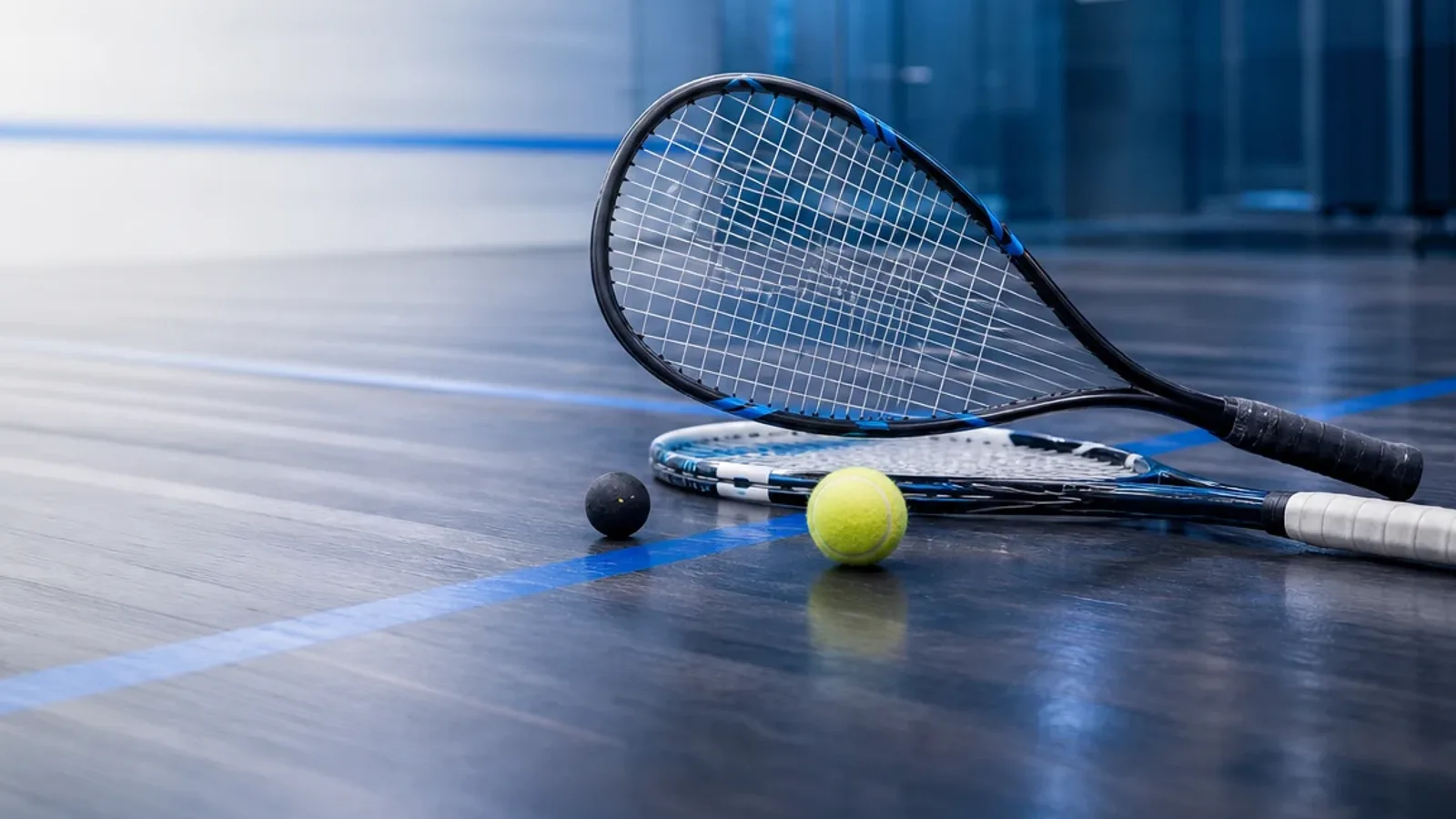
Squash vs tennis is a choice between a shared, walled box and an open court split by a net. In squash, two players stand in the same four-walled court and take turns striking a small hollow rubber ball to the front wall, which must land above the tin and below the out-line, and every rally wins someone a point in games to 11. In tennis, each player keeps to their own half of a court divided by a net, with a 0.914 m (36-inch) net at the centre on the 23.77 m by 8.23 m Green-stage court. Everything here comes from the governing bodies, World Squash with US Squash for squash and World Tennis (formerly the ITF) for tennis, all checked on November 25, 2026.
Squash vs tennis at a glance
| Squash | Tennis | |
|---|---|---|
| Who governs the rules | World Squash: Singles Rules 2025, in force since 1 September 2025 | World Tennis (formerly ITF): 2026 Rules of Tennis |
| Playing space | Enclosed court with four walls, shared by both players | Open court divided by a net; Green-stage court 23.77 m x 8.23 m |
| Boundaries | Tin at the bottom of the front wall, out-line along the front and side walls | Court lines; net 0.914 m high at the centre |
| Ball | Hollow rubber ball, 40.0 mm across and 24.0 g (World Squash standard) | Slower Red (foam or felt), Orange and Green felt balls for starters |
| Racket | Up to 686 mm long and 255 g | Covered by World Tennis racket and string documents |
| Scoring | Point-a-rally, games to 11, win by two from 10-all, best of 3 or 5 games | Several official formats; starters use tiebreaks and short sets to 4 |
| Starter path | Bouncier beginner balls, US Squash “Get Started” guide | Tennis Play and Stay, Tennis10s, Tennis Xpress for adults |
The court: one shared box or two halves
The biggest difference sits in the layout. US Squash describes squash as a game for two players on an enclosed court with four walls. The ball may hit the side and back walls at any point in a shot, as long as it reaches the front wall before touching the floor and stays inside the boundaries. The highest line on the front wall, which continues along both side walls, is the out-line; anything that hits on or above it is out. The lowest line is the tin, and the ball may not strike on or below it. Between them is the service line, and on the floor a left box, a right box and a half-court line split the back of the court.
World Squash keeps the technical detail in its court specifications. It calls 2026 a transition year: new specifications are being issued product by product, starting with flooring on 6 February 2026, lighting on 15 October 2026 and the wall, door and tin on 23 October 2026, and they replace the matching parts of the 2017 Full Court Specification. For the exact measurements of the singles court, see our comparison of squash vs racquetball.
Tennis has no walls in play. World Tennis lists the Green-stage court at 23.77 by 8.23 metres with a 36-inch (0.914 m) net at the centre, while the Red court for the youngest players is 10.97 to 12.8 m long and 4.88 to 6.1 m wide, and the Orange court is 17.98 to 18.29 m by 6.4 to 8.3 m.
Ball and racket
The World Squash standard ball, the double yellow dot used in competition, has a diameter of 40.0 mm (plus or minus 0.5) and weighs 24.0 g (plus or minus 1.0). The single yellow dot club ball has the same size and weight but a slightly higher rebound. World Squash also lists colour codes for speed: double yellow and green dot (for high altitude) as super slow, single yellow as slow, red as medium and blue as fast. US Squash adds a practical note: the ball starts out barely bouncy and speeds up once it has been warmed by several minutes of hitting.
The squash racket is capped by World Squash at 686 mm long, 215 mm wide, a 500 square-centimetre strung area and 255 g. Strings may be gut, nylon or a substitute, but not metal.
In tennis, the ball is where the starter path begins. Under Tennis10s, players aged 10 and under use slower balls on smaller courts. World Tennis estimates the Red ball as 75% slower than a Yellow ball, the Orange ball as 50% slower and the Green ball as 25% slower. Since 2012 the Rules of Tennis (Appendix VII) have required that competition for players aged 10 and under uses these Red, Orange and Green balls on the matching court sizes. World Tennis also runs approval programmes for balls and classification and recognition programmes for court surfaces, with details in its annual Technical Booklet.
Scoring and match length
Squash uses point-a-rally scoring, explained by US Squash in its beginner guide. A match is the best of three or five games, each game goes to 11, and from 10-all play continues until someone leads by two. Either player can score: a server who wins the rally scores and serves again, and a receiver who wins it scores and takes over the serve. To serve, part of one foot must be inside the service box, and the ball must hit the front wall between the service line and the out-line, then land in the back quarter on the opposite side unless the receiver volleys it.
Tennis has several official formats. World Tennis notes that the Rules of Tennis include a range of competition and scoring formats so clubs and coaches can match play to the players. For starters it recommends short formats: on the Red court a single tiebreak to 7 or 10, best of three tiebreaks to 7, a short set to 4 or timed matches; on the Orange and Green courts best of three tiebreaks to 7 or a short set to 4.
Intensity: why squash feels different
Squash rallies never stop at a net. After every shot both players have to move around each other inside the same box to reach the ball before its second bounce. US Squash calls it a contest of agility, strategy and mental and physical strength. Sharing the court also brings its own rules: a player is entitled to freedom from interference, and if a collision or a hit with the racket or ball is possible, players should stop and call a let. The rally is then replayed, or a stroke (the point) is awarded when the interference was substantial. Our guide on how to play squash walks through lets and strokes step by step.
Neither governing body page used here gives calorie or heart-rate figures for either sport, so we do not quote any.
Gear and getting started
For squash, US Squash lists four items: eyewear, racquet, shoes and balls. All players and coaches must wear protective eyewear during on-court play at US Squash accredited events. Courts have unsealed floors, so shoes must be non-marking, and running shoes are not recommended because they lack lateral support. For a first racquet, US Squash suggests trying several at a club pro shop. Beginners can also use bouncier balls; Dunlop’s single yellow, red and blue dot balls all bounce more than the double yellow dot and help produce longer rallies.
For tennis, the Tennis Play and Stay campaign aims for every starter to serve, rally and score from the first lesson, using slower balls. Adults have Tennis Xpress, a six-session course of nine hours in total (six sessions of 1.5 hours).
Neither sport’s governing body pages give prices, so the cost depends on your local club, court access and equipment. If squash is your pick, the Pharaoh Squash archive follows Egyptian players from the start: Juniors Take II covers age groups from U11 to U17, and training via streaming shows how coaches and juniors kept working during lockdown. For the broader picture, read What Is Squash? The Sport Explained or see Egyptian results in our 2021 review, part two.
FAQ
Is squash harder than tennis for beginners?
They are hard in different ways. Squash asks you to share a box with your opponent and keep the ball between the tin and the out-line. Tennis asks you to clear a net and keep the ball inside court lines. Both governing bodies offer slower or bouncier balls so beginners get longer rallies.
Can tennis players switch to squash easily?
The racket skills carry over, but the rules do not. In squash the walls are in play, the ball must reach the front wall before it touches the floor, and lets and strokes govern interference between players who share the court.
Is the squash ball smaller than a tennis ball?
Yes. The World Squash standard ball is 40.0 mm across and weighs 24.0 g. The slower tennis starter balls listed by World Tennis range from 6 to 9 cm across, depending on the stage and whether they are foam or felt.
How is squash scored compared with tennis?
Squash uses point-a-rally scoring to 11, win by two, in a best-of-three or best-of-five match. Tennis offers several official formats; for starters World Tennis recommends tiebreaks to 7 or 10 and short sets to 4.
Do I need eye protection for squash?
US Squash requires protective eyewear for all players and coaches during on-court play at its accredited events, and it says eye injuries in squash are almost totally preventable with the right equipment.
Which should I start with?
If you want a game US Squash describes as playable year-round in all kinds of weather, with fast rallies in a shared space, try squash. If you prefer an open court and a separate half for each player, tennis fits. Both have structured beginner paths run by their federations.
Sources
- World Squash: Rules of Squash
- World Squash: Ball Specification
- World Squash: Racket Specification
- World Squash: Court Specifications
- US Squash: Get Started (What Is Squash? / How to Play)
- US Squash: Squash Equipment
- World Tennis (ITF): Tennis Play and Stay
- World Tennis (ITF): Rules and Regulations
- World Tennis (ITF): Tennis Tech Resources