
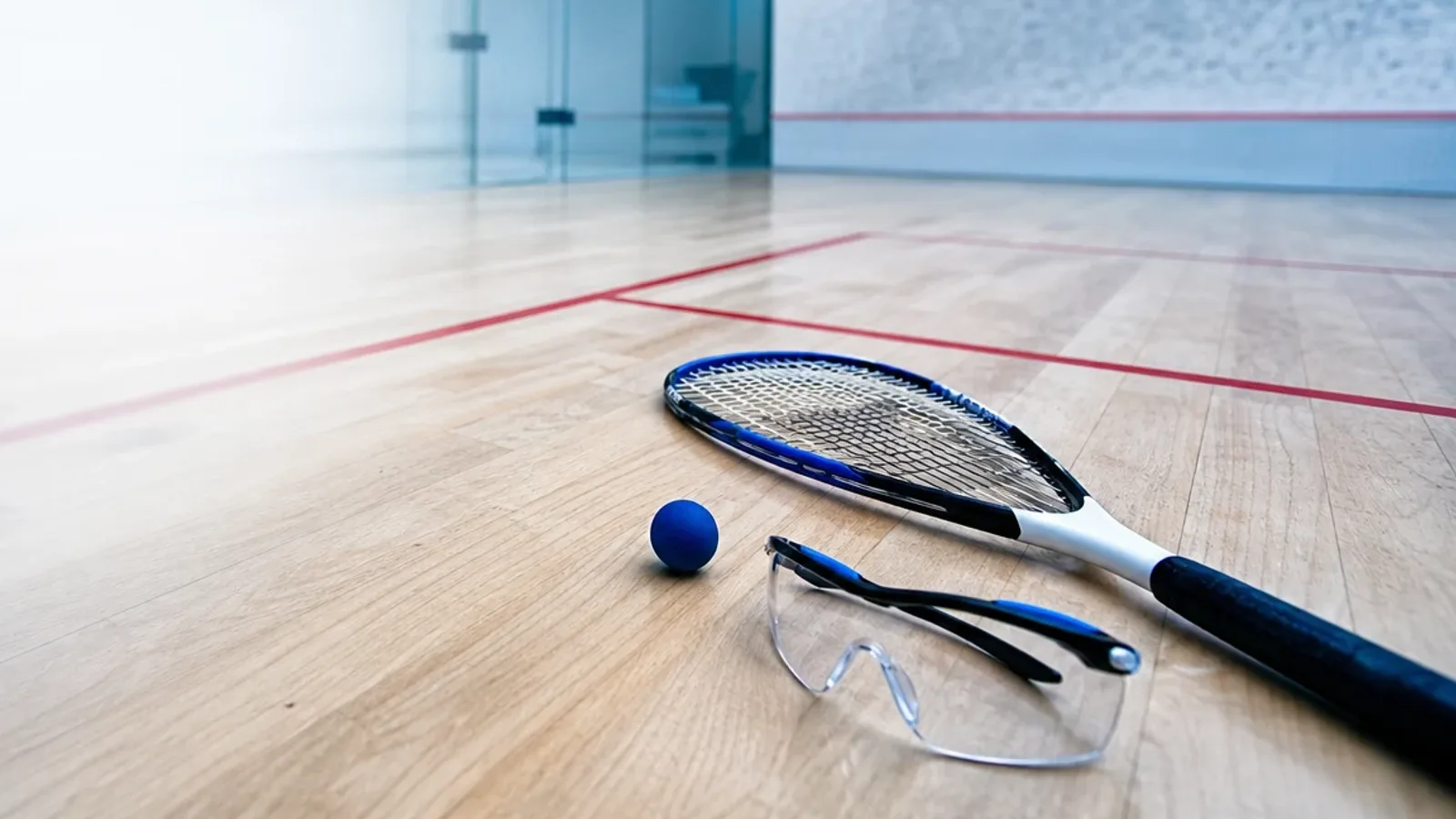
Here is how to play squash in one paragraph: two players share a four-walled court and take turns hitting a small rubber ball so that it reaches the front wall above the tin and below the out-line, before it has bounced twice on the floor. A rally starts with a serve, the winner of every rally scores a point, games go to 11 (win by two from 10-all), and a match is the best of three or five games. Everything below follows the World Squash Singles Rules 2025, the World Squash beginner guide and US Squash’s own pages for new players, all checked on November 24, 2026.
What you need before your first game
The kit list is short. World Squash’s getting-started guide asks for a racket, a ball and shoes without dark soles, and adds that a squash centre may lend you a racket and ball. Before you buy anything, a few points from US Squash are worth knowing:
- Shoes. Squash floors are unsealed, so you need non-marking shoes. US Squash says squash-specific shoes exist from several brands, that many players wear volleyball shoes, and that non-marking running shoes are not recommended because they lack the lateral support the game needs. Its quick test: drag the edge of the sole across a small patch of floor and see whether it leaves a mark.
- Racket. Rackets differ in weight, power, balance, grip and frame. US Squash suggests trying a range of rackets at your local club’s pro shop before you choose one.
- Ball. Beginners should not start with the professional ball. The standard double yellow dot ball bounces very little until it has been warmed up. US Squash lists Dunlop’s range from least bouncy to most as Competition (single yellow dot), Progress (red dot), Intro (blue dot) and Mini Squash, and World Squash’s guide tells beginners to ask for a larger introductory ball or a “faster” one such as white, blue or red dot.
- Eyewear. World Squash recommends protective eyewear for every player at all times during play, warm-up included, in social, league or tournament squash. It is mandatory at WSF-sanctioned doubles and junior events, and US Squash requires it for all players and coaches on court at its accredited events.
| Item | What the official pages say for beginners |
|---|---|
| Racket | Try several at a club pro shop; a centre may lend one |
| Ball | A bouncier ball (blue or red dot); move to single or double yellow later |
| Shoes | Non-marking, with lateral support; not running shoes |
| Eyewear | Recommended for everyone, during the warm-up too |
Know the court lines
You only need a few lines to start. World Squash’s court specification gives the singles court as 9,750 mm long and 6,400 mm wide (roughly 32 by 21 feet). On the front wall there are three horizontal marks:
- the out-line at the top, 4,570 mm high, which carries on along both side walls down to the back wall line at 2,130 mm;
- the service line across the middle, 1,780 mm high;
- the tin at the bottom, 480 mm high. World Squash’s beginner guide describes it as the low area of the front wall, about knee height, and the court specification says it is built to make a distinctive noise when the ball hits it.
On the floor, the short line crosses the court 4,260 mm from the back wall. The half-court line runs from the back wall up to the short line and splits the back of the court into two quarter-courts. The two lines meet in a T shape near the middle of the court. On each side, a square service box measuring 1,600 mm is marked out by the short line, the side wall and two more lines.
For a deeper look at how this box compares with a racquetball court, see our guide to squash vs racquetball.
How to play squash: the serve
Who serves first is decided by spinning a racket. Then the rules set out a sequence that is easy to practise on your own:
- Pick a box. At the start of each game, and every time the serve changes hands, the server chooses a service box. While you keep winning rallies, you switch boxes each time.
- Stand correctly. When you strike the ball, part of one foot must be on the floor inside the service box, and no part of that foot may touch the box’s lines.
- Drop or throw and hit. You drop or throw the ball from your hand or racket and hit it. If you drop it and make no attempt to swing, it does not count as a serve and you simply start again.
- Aim between the lines. The ball must go directly to the front wall and land between the service line and the out-line, without hitting the front wall and a side wall together.
- Send it across. Unless the receiver volleys it, the ball has to bounce first in the opposite back quarter-court, without touching a line.
There is no second serve. A fault means the receiver wins the rally, and a serve that touches the service line, short line, half-court line or any out-line counts as a fault.
What makes a return good
Once the serve is in, the players hit the ball alternately. Under the Singles Rules, a return is good when you strike it correctly before its second bounce, and it reaches the front wall above the tin and below the out-line without bouncing on the floor on the way. It can hit the side walls or the back wall first. US Squash puts the same idea simply: the ball must reach the front wall on the fly, and you can move anywhere on the court.
A rally ends when someone fails to do that. The marker’s three calls tell you why:
| Call | What it means |
|---|---|
| Down | The ball hit the tin, or the floor before reaching the front wall |
| Out | The ball hit a wall on or above the out-line, the top edge of a wall, or left the court |
| Not up | The ball bounced twice, was not struck correctly, or touched the striker |
“Correctly” has its own meaning in the rules: the ball is hit with the racket, held in the hand, only once and without prolonged contact. On the serve, World Squash’s guide adds that if you swing and miss, your opponent becomes the server.
Scoring: point-a-rally to 11
Squash uses point-a-rally scoring, which US Squash abbreviates as PAR. Whoever wins the rally scores one point and serves next, so when the receiver wins a rally, the serve changes hands. The marker calls this a “hand out” and always gives the server’s score first.
- A game goes to 11 points. At 10-all, play continues until one player leads by two.
- A match is normally the best of five games (first to three) but may be the best of three (first to two).
- The warm-up lasts up to 4 minutes, and the players change sides after 2. There is up to 1 minute before the first game and up to 2 minutes between games.
If you want the bigger picture of the sport around these rules, including its history and Egypt’s role, start with What Is Squash? The Sport Explained.
Sharing the court: lets and strokes
This is the part beginners find hardest, and both federations put safety first. The Singles Rules open with two principles: safety, meaning no action that could endanger the opponent, and fair play.
Clear after you hit. After a reasonable follow-through, you must make every effort to get out of the way so your opponent has a fair view of the ball, access to it, room for a reasonable swing and the freedom to hit it to any part of the front wall. In practice, after each shot you leave space and come back toward the middle of the court rather than standing where the ball is going.
Ask for a let. If your opponent is in your way, stop and say “Let, please”. US Squash recommends stopping whenever you might collide with your opponent or hit them with the racket or ball. The outcome depends on what happened:
| Situation | Decision |
|---|---|
| No interference and no reasonable fear of injury, or you could not have made a good return anyway | No let: you lose the rally |
| Your opponent made every effort to clear and you could have made a good return | Let: the rally is replayed from the same box |
| Your opponent did not make every effort to clear | Stroke: you win the rally |
| You would have hit a winning return | Stroke: you win the rally |
If the ball hits your opponent. World Squash’s beginner guide boils it down to: stop and do not play the shot if it is unsafe; if the ball was heading to a side wall first, it is a let; if it was heading straight to the front wall, it is a stroke. If you hit the ball back onto yourself, you lose the rally.
Do not turn without thinking. Turning means rotating so that you lose sight of the ball or your opponent, or letting the ball pass behind you from one side to the other. The beginner guide says it is safer to stop and ask for a let, and that if you turn and the ball then hits your opponent, your opponent wins the rally.
Court etiquette for new players
A lot of squash etiquette is written into the rules themselves:
- Share the warm-up. Both players must get equal chances to hit the ball; keeping it to yourself for too long counts as warming up unfairly.
- Wait for the receiver. The server must not serve before the receiver is ready.
- Keep play continuous. There is no “time out” for a rest. World Squash’s guide is clear that cramp is not a reason to stop: you play on or concede that game.
- Protect the floor. Check that your shoes are non-marking, and US Squash asks you to stop play straight away if you notice marks appearing.
- Call it honestly. The fair-play principle asks players to respect the officials and the opponent and to play with honesty, which matters most in friendly games with no referee.
Every champion started with these same basics. The Pharaoh Squash archive follows Egyptian players from junior events to the top, for example the junior finals in Juniors Take II: from U11 to U17, how coaches and juniors kept working in Lockdown? No problem, training via streaming, and Marwan ElShorbagy on the coach behind his career in Haitham Effat is the reason I am playing at the level I am. For a look at the top of the professional game, read our profile of Ali Farag or browse the Pharaoh Squash blog.
FAQ
Is squash hard to learn? The basic rule is simple: hit the ball to the front wall, above the tin and below the out-line, before it bounces twice. US Squash describes the game as one for players of every skill level. A bouncier beginner ball makes early rallies much easier to keep going.
Which ball should a beginner use? A livelier ball than the professionals use. US Squash lists the order from least bouncy to most as double yellow dot, single yellow dot, red dot, blue dot and Mini Squash, and World Squash suggests white, blue or red dot balls for beginners.
Can the ball hit the side walls? Yes. A return may hit the side walls or the back wall on its way, as long as it reaches the front wall above the tin and below the out-line before bouncing on the floor.
How many points is a squash game? Eleven. If the score reaches 10-all, the game continues until one player is two points ahead. A match is usually the best of five games.
Do I really need eye protection? World Squash recommends protective eyewear for all players at all times during play, including the warm-up and friendly games. It is compulsory at WSF-sanctioned doubles and junior events and at US Squash accredited events.
What is the difference between a let and a stroke? A let means the rally is replayed and nobody scores. A stroke means the player who was obstructed wins the rally, for example when the opponent did not make every effort to get out of the way.
Sources
- World Squash: Singles Rules 2025 (effective 1 September 2025)
- World Squash: Rules of Squash
- World Squash: Squash – Getting Started
- World Squash: Specifications for Squash Courts
- World Squash: Ball Specification
- US Squash: Get Started (What Is Squash? / How to Play)
- US Squash: Squash Equipment
- US Squash: Squash Rules & Resources