Squash is a racket sport in which two players take turns hitting a small ball against the front wall of a four-walled court. The squash sport is simple to describe: each rally starts with a serve, the players then return the ball alternately, and a return is good if it is struck before its second bounce and reaches the front wall above the tin and below the out-line. Whoever wins the rally scores a point, games go to 11, and a match is usually the best of five games. Everything below is checked against World Squash (the sport’s international federation), the PSA Squash Tour and the IOC on November 18, 2026.
The squash sport in one table
| What the official documents say | |
|---|---|
| Players | Two in singles, each with a racket |
| Court | 9,750 mm long and 6,400 mm wide (about 32 by 21 ft) |
| Front wall markings | Out-line at 4,570 mm, service line at 1,780 mm, tin up to 480 mm |
| Back wall | Out-line at 2,130 mm |
| Ball | 40 mm across, 24 g; double yellow dot for competition |
| Racket | Up to 686 mm long, 215 mm wide and 255 g |
| Who scores | The winner of every rally |
| Game | First to 11; at 10-all, play on until one player leads by 2 |
| Match | Normally best of 5 games, sometimes best of 3 |
| Eye protection | Recommended for everyone; mandatory in WSF doubles and junior events |
Imperial figures in brackets are rounded; World Squash publishes its measurements in millimetres.
How a rally works
The serve. A spin of a racket decides who serves first. The server drops or throws the ball and hits it while one foot is inside a service box, with no part of that foot on the box’s lines. The ball has to go straight to the front wall, landing between the service line and the out-line, and then, unless the receiver volleys it, bounce first in the opposite quarter of the court without touching a line. There is no second serve: a fault means the receiver wins the rally. While the server keeps winning points, they switch between the two service boxes.
The rally. After a good serve, the players hit the ball in turn. Under the World Squash Singles Rules, a return is good when it is struck before it has bounced twice and reaches the front wall, directly or after hitting other walls, above the tin and below the out-line, without bouncing on the floor first. So the side walls and the back wall are part of the game, which is why squash rallies have so many angles.
How a rally ends. A return is “down” if it hits the tin, or the floor before the front wall. It is “out” if it hits a wall on or above the out-line, touches the top edge of any wall, or leaves the court. The tin itself is defined as the strip of front wall that runs the full width of the court, from the floor up to and including the lowest line.
Getting out of the way. Two players share one small court, so the rules spend a lot of time on interference. After a reasonable follow-through, a player must make every effort to clear so the opponent has a fair view of the ball, access to it, space for a reasonable swing and the freedom to hit it to any part of the front wall. If that does not happen, the striker can ask for a let. Depending on the situation, the referee replays the rally (a let, which neither player wins) or awards it to the striker (a stroke).
Scoring: point-a-rally to 11
Squash uses point-a-rally scoring. The winner of each rally scores one point and serves to start the next one, so the score moves on every rally, whoever served. A game is played to 11 points; if it reaches 10-all, play continues until one player is two points ahead, and the marker announces exactly that. A match is normally the best of five games but may be the best of three.
The clock is part of the format too. The warm-up lasts up to 4 minutes, with the players changing sides after 2. Between the warm-up and the first game there is a maximum of 1 minute, and between games a maximum of 2 minutes.
If you want to see how this compares with a sport that only lets the server score, our guide to squash vs racquetball puts the two rulebooks side by side.
Court, ball and racket
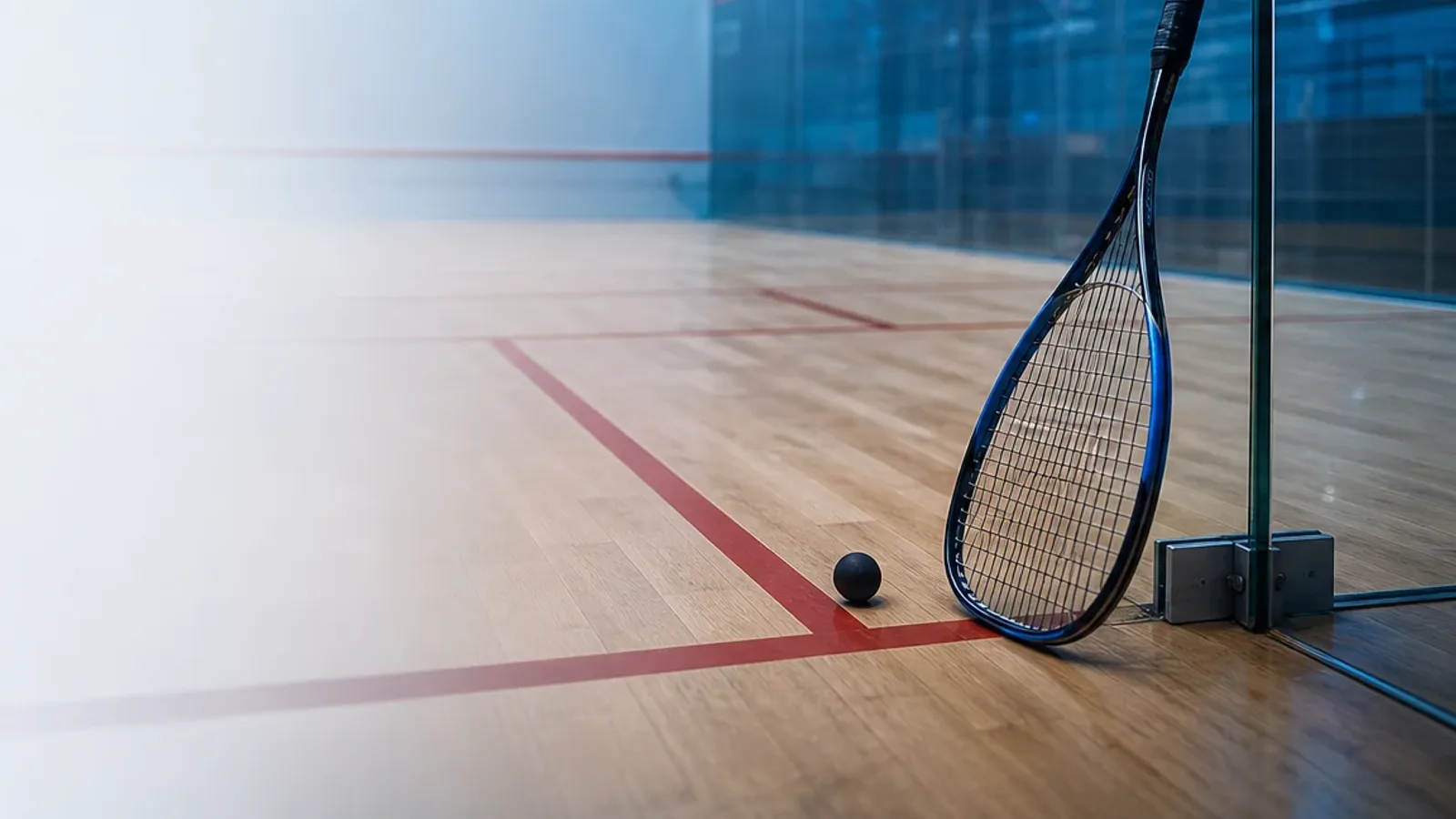
The court. World Squash gives the international singles court as 9,750 mm long and 6,400 mm wide. On the front wall, the out-line sits at 4,570 mm and the service line at 1,780 mm. The standard tin height is 480 mm, though the court specification notes that a lowered tin of 430 mm is preferred for all PSA-sanctioned tournaments. On the floor, the short line runs across the court 4,260 mm from the back wall, the half-court line splits the back of the court into two quarters, and a square service box sits on each side.
The ball. The double yellow dot competition ball is 40.0 mm in diameter (plus or minus 0.5) and weighs 24.0 g (plus or minus 1.0). Its minimum rebound at 23 degrees C is 12% when dropped from 254 cm. The single yellow dot club ball has the same size and weight with a slightly livelier rebound. World Squash recommends livelier balls for beginners and improvers, and its speed guide runs from super slow (double yellow dot) and slow (single yellow) to medium (red) and fast (blue).
The racket. The racket specification sets a maximum length of 686 mm, a maximum width of 215 mm, a maximum strung area of 500 square centimetres and a maximum weight of 255 g. Strings can be gut, nylon or another substitute, but not metal, and the frame and bumper strip must not mark the walls or floor.
Eyewear. World Squash recommends that all squash players wear protective eyewear made to an appropriate national standard, for the whole match, warm-up included, in social, league and tournament play alike. For WSF-sanctioned doubles and junior events it is mandatory.
A short history of squash
According to World Squash’s court specification, squash is believed to have grown out of the game of rackets at Harrow School in England around 1830. Rackets was played with a hard ball, on a concrete court roughly double the length of today’s squash court. Pupils found that a punctured rackets ball, which “squashed” when it hit the wall, gave a game with more variety of shots and demanded more effort, because players could no longer wait for the ball to come back to them. The first four squash courts were built at the school in 1864, which the document treats as the official founding of squash as a separate sport.
The courts themselves changed a lot. The same document says that until the 1960s most squash courts were four plastered white walls, often with a balcony for spectators. Glass back walls became popular from the mid-1960s, and today four-sided glass show courts are common at tournaments, seating thousands around a single court. World Squash lists dramatic venues for these portable courts, and the first one it names is the Pyramids in Cairo.
World Squash describes itself in the same document as the sole international federation for squash recognised by the IOC, responsible for the rules, the court and equipment specifications, refereeing and coaching. It puts the game at around 185 countries and roughly 50,000 courts.
The biggest recent step came on 16 October 2023. The 141st IOC Session in Mumbai approved squash as one of five additional sports proposed by the Los Angeles organisers for the 2028 Games, and squash will make its Olympic debut at LA28. The IOC notes that the five sports were proposed as a package for that edition only.
Egypt’s place in squash
The professional game is played on the PSA Squash Tour, which publishes separate world rankings for men and women. On the day this guide was checked, both World No.1 spots belong to players whose PSA profiles list Egypt as their birthplace.
- Men: Mostafa Asal tops the PSA World Rankings, ahead of Paul Coll and Diego Elias. His PSA profile gives his birthplace as Egypt and his date of birth as 9 May 2001. Our archive followed him on the way up in Mostafa Asal: working hard to reach World No.1.
- Women: Amina Orfi is the PSA women’s World No.1. The PSA reported on 21 September 2026 that she reached the top at 19 years and two months, the youngest woman ever to hold the ranking, breaking the record Susan Devoy set in 1984. She got there by beating then-No.1 Hania El Hammamy in the QTerminals Qatar Classic final, and the PSA notes that 2026 also brought her the World Championship and the British Open.
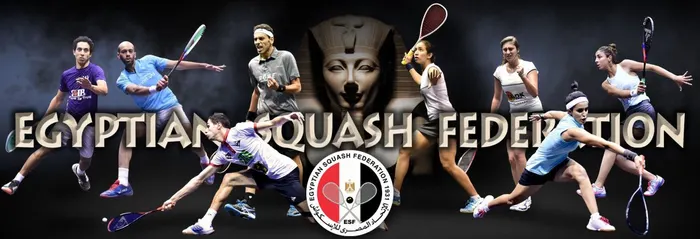
Egypt’s squash story is much older than this season, and the Pharaoh Squash archive holds hundreds of posts on it. Look back at our report from the CIB Worlds, fourth title for Nour, the rise of Hania El Hammamy in December rankings: the Gazelle in the top 10, or browse all our World Championship coverage and the El Gouna tournament archive. New guides go up on the Pharaoh Squash blog.
FAQ
What is squash in simple terms? A racket sport for two players in a four-walled court. Players take turns hitting the ball so that it reaches the front wall above the tin and below the out-line, and the rally ends when someone fails to make a good return.
How do you score in squash? Every rally scores a point for its winner. Games go to 11, but at 10-all a player has to win by two points. A match is normally the best of five games.
How big is a squash court? The World Squash singles court is 9,750 mm long and 6,400 mm wide, about 32 by 21 feet. The out-line on the front wall is at 4,570 mm and the standard tin is 480 mm high.
Why is it called squash? World Squash’s court specification explains that pupils at Harrow School found a punctured rackets ball “squashed” on impact with the wall, and the game played with it became squash.
Is squash an Olympic sport? Yes, from LA28. The IOC approved squash as an additional sport for the Los Angeles 2028 Games on 16 October 2023, and it will make its Olympic debut there.
Who are the best squash players right now? On November 18, 2026, the PSA World Rankings had Mostafa Asal at No.1 for men and Amina Orfi at No.1 for women. Rankings change regularly, so check the PSA rankings page for the latest order.
Sources
- World Squash: Singles Rules 2025 (effective 1 September 2025)
- World Squash: Rules of Squash
- World Squash: Specifications for Squash Courts
- World Squash: Ball Specification
- World Squash: Racket Specification
- PSA Squash Tour: World Rankings
- PSA Squash Tour: Mostafa Asal player profile
- PSA Squash Tour: Amina Orfi Becomes The Youngest Female World No.1 In History
- PSA Squash Tour: Amina Orfi player profile
- IOC Newsroom: IOC Session approves LA28's proposal for five additional sports